OIR Testing:
There’s no negative marking in these tests.
The common misconception about OIR test is that it didn’t get much weightage as compare to PPDT in assessment. It is a set of both verbal and nonverbal reasoning test. The candidate has to solve more number of questions in less time. Candidates have to atleast clear this exam with minimum cut off marks no matter how well his/her PPDT has gone. There are no shortcuts when it comes to Officer Intelligence Rating test preparation, candidate has to go through the syllabus and pick the topics one by one and start preparing for it, more a candidate practice on the topics the better his/her performance will be. The questions asked in Officer Intelligence Rating Test are very basic and can be mastered with a little bit of daily practice.
- Verbal Reasoning
- Non Verbal Reasoning.
- Analogy and Classification.
- Coding – Decoding.
- Number Series.
- Blood Relations.
- Direction .
- Seating Arrangement.
- Puzzles.
- Basic mathematical aptitude.
- Analogy and Classification of figures.
- Complete and Incomplete Pattern of figures
- Cubes and Dice
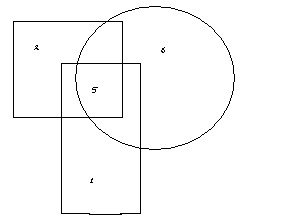
- Venn Diagram (simple one)
Ans: North. Draw the direction on the paper then solve it.
Ans: ABEDC.

PPDT (Picture Perception & Discussion Test) :
In this test,a hazy & blurred image is projected on the screen. The candidates are given 30 seconds for watching the image. After 30 seconds, the image is called off the screen. The candidates are given 30 seconds, to mark the characters they saw in the image in a box made on the sheet & write their age, sex & mood. Candidate also need to write the action of the story in one line. After that, candidates are given 3 minutes to write their story on the sheet. All this is a continuous process & after 4 minutes the sheets are taken by the officials & the candidates are grouped for discussion. The number of candidates in a group depends upon the group strength & the no. of students who have reported.
Usually, different groups are made for Fresher Candidates, Screened Out Candidates, Conference Out Candidates & Previously Recommended Candidates.
After the group is divided, the candidates are asked to sit in a semicircular fashion. The assessors will guide about the process & will ask the first candidate to start his narration. Approximately 1 minutes is given to each candidate for narration of his story but sometimes, if a candidate is struck or the assessors get the main idea , they ask next candidate to narrate his story. As soon as a candidate finish his narration the next candidate is supposed to narrate his story. After all the candidates are done with the narration, one of the assessor will ask the group to start the discussion. After the discussion, the candidates are sent outside in the waiting hall & soon the Stage 1 results are declared. Performance in the PPDT assumes a great importance in clearing the Screening Test.
PPDT Story Writing Tips:
- Utilise the time given to observe the picture carefully.
- Fill up details about the characters that you have perceived in the box as directed by the Psychologist during his briefing.
- Look at the background of the hazy picture projected. The same would decide the setting of your story, i.e. rural, urban, market place, stadium, etc.
- Now look at the foreground and see how many characters do you see in the picture.
- Identify the main character and give him/her a name, you would invariably identify the main character closest to your own age group.
- Write the Center Heading of you story, which will represent the action that you have perceived in the picture.
- The story that you write must give out the following: What led to the scene that you have perceived, What is presently going on in the scene and what would be a logical outcome of the scene that you have perceived.
- Remember the characteristics portrayed by the main character are a refection of your personality attributes. Also, the theme of the story will represent your mental make up, i.e. constructive/destructive, optimist/pessimist, etc.
- Hence, write a positive, constructive, realistic and a story that depicts a mature mind who is very well informed. You could make a story on some current themes, e.g. Crime against women, ragging, infrastructure development, water conservation, communal harmony, etc.
- You could show your awareness level by giving more of the actions done by the main character to achieve the goals that he set for himself.
- Since, you only get 4 mins to write your story it must be concise and to the point.
- Don’t worry about grammatical errors or handwriting.
- Don’t worry if you’re not able to complete your story, Try to narrate your story effectively.
PPDT Narration & Group Discussion:
Narration Tips:
- Never look at the assessors while narrating your story or any other point of time.
- Most important part is the individual narration of your story. If you do it right, you will almost make it through. Make sure that you are able to give out your story confidently, clearly and within one minute. Do rehearse it many times before you are called in for the discussion.
- Keep your story crisp & clear & do mention the number of characters you saw, their age, sex & mood.
- Maintain a good eye contact with every group member while narrating your story & try not to use more of hand gestures as it shows that you need help to justify your points.
- Maintain a good sitting posture & don’t lean too forward, hold your back straight & don not lose your temper at any point of time. Be calm, you’ll make it.
- Listen to everyone’s story very intently and identify the common thread emerging in their stories.
Group Discussion Tips:
- Do not promote your own story, but, go on to support the common theme of the story.
- Do not contribute with low level inputs like, how many characters, what were their ages, etc, but give quality contribution that shows your general awareness.
- Act as a moderator in the discussion by assisting the group to come to a common theme.
- Encourage everyone to participate and be sensitive to other people’s views. You should be seen as a very polite, decent and pleasant person.
- Once a common theme has been selected by the group, participate with quality points that shows your high caliber and knowledge.
- Do not loose your composure, do not get aggressive, and tactfully deal with some candidates who are group disruptive and rude.
- Do not speak too long at one time, but, at the same time make sure that you are positively visible through out the discussion.
 SSB School